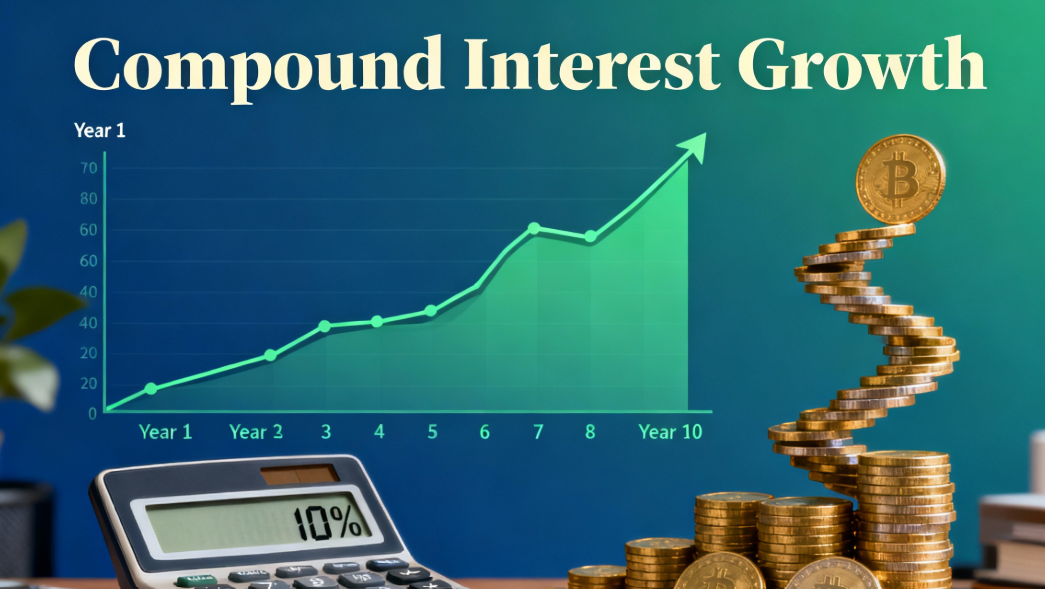
Compound Interest Calculator
Table of Contents
Introduction
Understanding how your investments grow over time is central to realizing financial independence. The Compound Interest Calculator will help you correctly project growth, whether you save for retirement, build a fixed deposit, or evaluate long-term investment returns. Take the guesswork out of compounding and see how small savings today can add up to sizeable wealth tomorrow.
What is Compound Interest?
Compound interest means the interest accrued both on the principal amount and on the interest of previous periods. It lets your money grow faster than simple interest, because interest is earned not only on your deposit but also on the interest it earns.
How to Use the Compound Interest Calculator
- Enter Principal Amount (₹):
Type the initial investment or deposit amount in the box labeled "Enter principal amount". - Enter Annual Interest Rate (%):
Fill in the yearly interest rate (as a percentage) offered by your bank, investment, or fixed deposit in the box labeled "Enter interest rate". - Choose Compounding Frequency:
Select how often the interest should be compounded (e.g., Monthly, Quarterly, Annually) from the dropdown menu labeled "Compounding Frequency". - Enter Time (Years):
Specify the investment duration (in years) in the box labeled "Enter number of years". - Click 'Calculate':
Press the blue "Calculate" button at the bottom. The calculator will then show you the total accumulated amount and the interest earned over your chosen period.
Compound Interest Formula
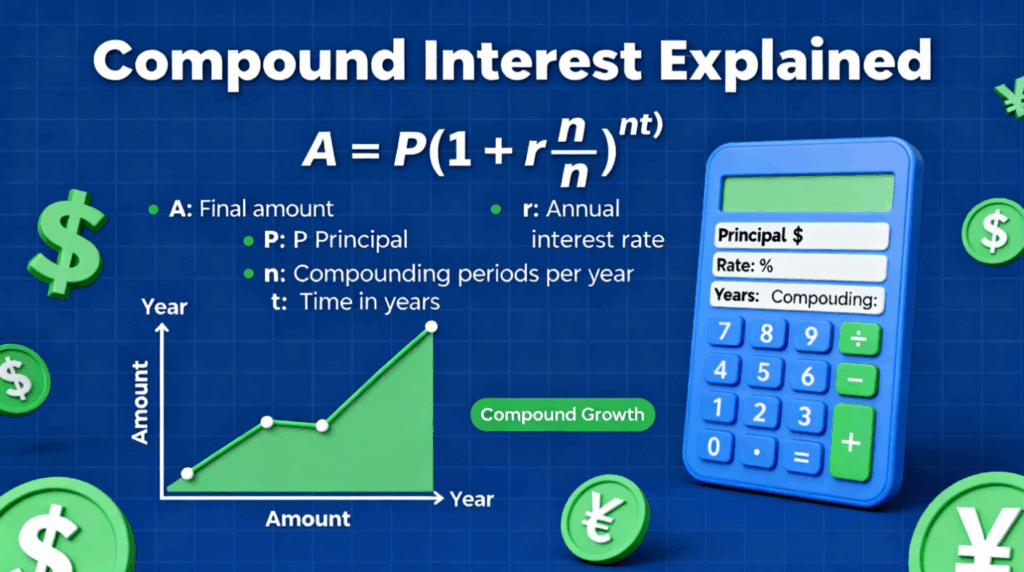
The standard compound interest formula is:
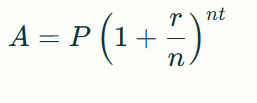
Where:
- AA = Final amount after time t
- PP = Principal (initial investment)
- rr = Annual interest rate (in decimal)
- nn = Number of times interest compounds per year
- tt = Number of years
Example: If you invest ₹1,00,000 at 8% annual interest compounded monthly for 10 years, your future value will be:

Types of Compound Interest Calculators
- Compound Interest Rate Calculator: Helps you determine what annual rate you need to reach a target amount.
- Compound Interest Retirement Calculator: Estimates how your savings grow for retirement over decades.
- Compound Interest Calculator for Fixed Deposit (FD): Specifically built for FD schemes offered by banks.
- Compound Interest Calculator Excel Version: Useful for investors who track growth using Excel sheets.
Benefits of Using a Compound Interest Calculator
- Visualizes wealth growth over time
- Compares investment options accurately
- Helps plan long-term goals like retirement or education
- Evaluates how increasing compounding frequency impacts returns
Frequently Asked Questions
What is the difference between simple and compound interest?
Simple interest only applies to the principal, while compound interest is calculated on both principal and accumulated interest.
How often should compounding occur for higher returns?
More frequent compounding (monthly or daily) leads to higher returns than annual compounding.
Is compound interest better for loans or investments?
Compound interest benefits investors but increases the cost of debt for borrowers.
How do fixed deposits earn compound interest?
Banks typically compound FD interest quarterly or annually depending on the product type.
Can I calculate compound interest in Excel?
Yes. Use the formula =P*(1+r/n)^(n*t) where each variable matches the parameters above.
Reference Links
- Investopedia – Compound Interest Explained
- RBI – Fixed Deposit Interest Information
- Wikipedia – Compound Interest
Disclaimer
The compound interest calculator provided here is for educational purposes only. While every effort is made to ensure accuracy, results may vary based on rounding, compounding frequency, and rate variations. Please consult with your financial advisor before making investment decisions.